On the morning of January 15, 1971, at the main market square in Bafoussam, the Cameroonian state brought an end to the life of Ernest Ouandié. Decades later, his name remains inseparable from the struggle for Cameroon's true sovereignty, resistance to colonial and post-colonial domination, and the refusal to bend before injustice.
He was not alone. Beside him stood Gabriel Tabeu, famously known as "Wambo le Courant," and Raphaël Fotsing — his comrades in arms, his brothers in the fight. They would die together, as they had fought together.
Ouandié was handcuffed. The soldiers offered to blindfold him. He refused, choosing to face his executioners with open eyes.
He stood before the rifles, straight and unbroken before the French army officer who commanded the squad — a stark symbol of the post-colonial military ties backing the Ahidjo regime. The local population, including market women and school children, was forcibly summoned to witness the execution to serve as a terrifying example. Witnesses later said Ouandié was calm, almost serene.
Then he spoke his final words. While historical accounts record slight variations in his exact phrasing, the unwavering essence of his final cry echoed across the crowded square:
The French commanding officer gave the order, and a volley of rifle fire cut the three men down. To ensure the execution was complete, the French officer then stepped forward to personally deliver the definitive coup de grâce, firing a final pistol shot to the head. This ruthless display marked the symbolic end of the armed UPC resistance, leaving a profound scar on Cameroon's path to unification.
In plain English: Ernest Ouandié was the last commander of the armed struggle against French colonial rule and the Ahidjo government. He died without a blindfold, without fear, and without betraying his cause.
Early Roots and Formative Scars
Long before he became a revolutionary leader, Ernest Ouandié's worldview was shaped by the harsh realities of French mandate rule in western Cameroon.
Born in 1924 in the village of Badoumla, located within the Bana district of the Haut-Nkam division, he was named Ouandié — a Bamiléké name translating conceptually to "Who is in safety?".
He was the fifth of seven children born to his mother, Kapsu, who was one of three wives married to his father, Djemo.
In 1927, when Ernest was only three years old, a profound family trauma struck. Under the brutal colonial system of forced labor known as l'indigénat, French authorities arrested Djemo and deported him to work on colonial coffee plantations in Djimbong.
When his father finally returned in 1929, his health was permanently broken. Witnessing the physical toll of this structural cruelty throughout his childhood instilled in the young Ouandié an early, enduring intolerance for colonial injustice.
In 1933, his uncle, Kamdeu Sango, enrolled him in formal Western education at the Bafoussam Public School in the Famla neighborhood. Recognizing his sharp intellect, teachers pushed him forward to the Dschang Regional School in 1937 for his upper primary education. He graduated at the top of his cycle in 1940, earning his Certificat d'Études Primaires Élémentaires (CEPE).
His academic excellence won him a highly competitive admission to the prestigious École Primaire Supérieure de Yaoundé. There, he trained intensely for three years, culminating in his graduation on October 21, 1943, with his Diplôme des Moniteurs Indigènes (DMI). At just nineteen years old, he was officially certified as an indigenous public school teacher for the colonial administration.
In plain English: Ouandié grew up in a large Bamiléké family and saw his father broken by French forced labor. He excelled in colonial schools, eventually graduating from a top academy in Yaoundé to become a certified teacher.
The Making of a Militant
From early 1944, Ernest Ouandié engaged in trade unionism, immediately joining the Union of Confederal Trade Unions of Cameroon (USCC) upon arriving at his first teaching post in the highly industrial, heavily unionized town of Edéa.
Because the USCC was structurally affiliated with the French General Confederation of Labour (CGT), it was deeply influenced by Marxist organizers. The classroom was not enough — he needed to organize.
It was within these structured union circles that Ouandié met Ruben Um Nyobé, the chief mobilizer of the movement. Um Nyobé was instantly drawn to Ouandié’s rigid self-discipline, total lack of personal ego, and exceptional pedagogical skills.
The two men forged a powerful bond over a shared philosophy: they firmly believed that true liberation could not be achieved through elite diplomatic compromises, but required mass political literacy among the ordinary Cameroonian workers and peasants.
The French colonial authorities grew increasingly wary of Ouandié's outspokenness and anti-colonial lessons. On October 7, 1948, the administration issued a swift, punitive disciplinary transfer to Dschang to break up his growing local network.
When that failed to silence him, they abruptly reassigned him exactly one month later, on November 6, 1948, to the economic capital of Douala, appointing him Director of the New-Bell Bamiléké public school.
This strategy completely backfired on the colonial state. Moving Ouandié to Douala placed him directly at the epicenter of radical Cameroonian intellectualism.
Though a small group of twelve radical trade unionists — including Léonard Bouli and Charles Assalé — had already formally deposited the statutes to found the Union of the Peoples of Cameroon (UPC) on April 10, 1948, it was the arrival of Um Nyobé as Secretary General and Ouandié as a core organizer later that year that transformed the fledgling party into a massive, unstoppable popular vanguard.
Ouandié embraced the UPC ideal completely: total, immediate independence and reunification, entirely free from foreign trusteeship.
His punitive transfers continued across the country — from Douala to rural schools in Doumé, Yoko, and Batouri in the East Region — as the colonial authorities tried desperately to curb his influence. They knew exactly who he was, and they tried to isolate him by moving him to remote outposts.
But each transfer became an unexpected opportunity. Every new rural post was a chance for Ouandié to radicalize the peasant population, expand clandestine UPC networks, and reach the most distant corners of the territory.
By September 1952, during the party's historic Eséka Congress, his peerless organizational skills led to his election as the Vice-President of the UPC, placing him in charge of organizing the entire national movement. He also took over the leadership of La Voix du Cameroun, the party's radical newspaper.
The pen, like the rifle, was a weapon.
The Revolutionary Abroad: China, Paris, Moscow
In 1954, Ouandié's commitment took him beyond Cameroon's borders. As Vice-President of the UPC, he traveled to China, Paris, and Moscow— a journey that would consolidate his revolutionary convictions and place the Cameroonian struggle within a broader, international context.
He saw firsthand how other nations had successfully thrown off colonial chains. He studied revolutionary warfare, Marxist geopolitical theory, and international solidarity.
He returned to Cameroon with a vastly broader vision of what true independence could mean, looking far past the borders of the French empire.
This international experience permanently distinguished him from many other nationalist leaders of his era. He was no longer merely a local, territorial dissident. He was a seasoned revolutionary with a global perspective, ready to position Cameroon's independence movement at the forefront of the global anti-imperialist front.
In plain English: Ouandié traveled to Communist China, the Soviet Union, and France. He saw how revolution worked elsewhere. He brought those lessons home.
The May 1955 Uprisings and the Fracture of Empire
By early 1955, the political temperature in French Cameroun had reached a boiling point. High Commissioner Roland Pré, appointed by Paris to crush the nationalist movement, initiated a aggressive campaign to systematically isolate the UPC.
The colonial administration weaponized the judiciary, blocked nationalist assemblies, and heavily pressured traditional chiefs and Catholic clergy to denounce the party as an atheist, communist threat.
The UPC refused to back down. Throughout April 1955, Ernest Ouandié, Ruben Um Nyobé, and Félix-Roland Moumié crisscrossed the country, organizing mass rallies and distributing radical pamphlets.
They issued a historic joint proclamation demanding the immediate termination of the United Nations trusteeship, total national sovereignty, and the creation of a sovereign constituent assembly.
The spark was officially struck in late May 1955. Simultaneously across Cameroon’s major urban centers—including Douala, Yaoundé, Nkongsamba, Loum, and Mbanga — the accumulated tension erupted into a wave of massive, coordinated popular uprisings. Striking labor workers, urban youth, and UPC militants barricaded roads, cut telegraph lines, and clashed directly with colonial security forces.
The French response was swift, disproportionate, and devastating. High Commissioner Pré deployed heavily armed military reinforcements, authorizing the use of live ammunition against the civilian population.
In Douala, French military vehicles patrolled the neighborhoods of New-Bell and Akwa, firing indiscriminately into crowded streets. The colonial state systematically burned down the UPC national headquarters and raided the homes of its leadership.
While the official colonial records conservative reported a minimal death toll, independent historical investigations reveal that hundreds — and likely thousands — of Cameroonian civilians and militants were killed, injured, or systematically rounded up into mass detentions during the bloody week of suppression.
On July 13, 1955, the French government in Paris delivered its final structural blow. Invoking a 1936 French law originally designed to dissolve domestic fascist militias, the French Council of Ministers officially issued a decree outlawing the Union of the Populations of Cameroon (UPC), along with its affiliated wings, including the women's branch (Union des Femmes Camerounaises - UFC) and the youth branch (Jeunesse Démocratique du Cameroun - JDC).
The party was completely stripped of its legal status, its assets were confiscated, and warrants were issued for the immediate arrest or execution of its executive bureau.
Forced into an instant tactical corner, Ernest Ouandié and his closest comrades were compelled to abandon their open, public legal battles. They packed their essential documents, slipped past military blockades, and vanished into the dense forests and cross-border sanctuaries to launch one of Africa’s most protracted clandestine revolutionary struggles.
In plain English: In May 1955, major Cameroonian cities erupted in mass anti-colonial protests. The French military crushed the uprisings with brutal force, killing hundreds, and officially banned the UPC on July 13, 1955, forcing Ouandié and his comrades into hiding.
The Long Wilderness: Transition into Exile (1955–1961)
When the banning decree dropped, Ernest Ouandié, Félix-Roland Moumié, and Abel Kingué did not flee far. In July 1955, they slipped across the border into British Southern Cameroons, establishing their initial underground headquarters in Kumba before expanding their operational cells to Tiko and Bamenda.
For two years, the British-administered territory served as a vital sanctuary. From Kumba, Ouandié utilized his deep organizational skills to manage a highly effective cross-border smuggling network.
They funneled pro-independence newspapers, letters, and instructions back into French Cameroun, keeping the banned party alive in the minds of the population.
However, the French government placed immense diplomatic pressure on London to neutralize the dissidents.
In June 1957, the British authorities yielded, officially outlawing the UPC within their territory and deporting Ouandié and his comrades to Khartoum, Sudan.
Displaced from their immediate borders, the exiled leaders entered the global stage, transforming the UPC into a highly visible international anti-imperialist movement.
They eventually gravitated toward Cairo, Egypt, where President Gamal Abdel Nasser granted them diplomatic asylum, office space, and broadcasting rights on the state radio network.
From Cairo, the exiled leadership split into a highly effective global vanguard: Félix Moumié operated as the charismatic international diplomat, while Ernest Ouandié worked behind the scenes as the rigorous geopolitical strategist.
The changing tides of African decolonization soon shifted their base of operations westward. Following Guinea's historic independence in 1958, President Ahmed Sékou Touré welcomed the UPC to Conakry.
Shortly after, Ghana's champion of Pan-Africanism, Kwame Nkrumah, invited them to set up a powerful bureau in Accra.
From Accra and Conakry, Ouandié negotiated directly with foreign superpowers. He traveled extensively back to Beijing and Moscow, securing financial grants, ideological backing, and military training scholarships for young Cameroonian cadres.
This period of exile, however, was plagued by immense heartbreak and structural isolation. On September 13, 1958, French forces tracked down and assassinated Ruben Um Nyobé in the forests of Sanaga-Maritime. The loss of the Mpodol deeply fractured the party's internal communications.
Two years later, on November 3, 1960, French secret agents using the undercover operative William Bechtel assassinated UPC President Félix-Roland Moumié in Geneva, Switzerland, using lethal thallium poison.
Left as the senior surviving custodian of the revolutionary flame, Ernest Ouandié recognized that international diplomacy from distant African capitals had reached its limits. The time had come to bring the revolution back to the soil of Cameroon.
In plain English: Deported by the British from Kumba and Bamenda, Ouandié and his comrades set up exile bases in Egypt, Guinea, and Ghana. Despite the assassinations of Um Nyobé in 1958 and Moumié in 1960, Ouandié secured military aid from China and Russia, preparing to return home.
The Return to the Maquis: Command of the ALNK (1961–1970)
In July 1961, just as French Cameroun and British Southern Cameroons were finalizing their reunification, Ernest Ouandié made a monumental, fateful decision.
He turned his back on the safety of foreign capitals, packed his journals, and secretly smuggled himself back into Cameroon. Slipped across the border under an assumed identity, he descended directly into the dense, volatile forests of the Mungo and West regions to assume total leadership of the Armée de Libération Nationale du Cameroun (ALNK) — the armed wing of the UPC.
Operating from subterranean, deeply concealed forest camps known as the Maquis, Ouandié faced a brutally altered geopolitical reality.
Ahmadou Ahidjo was now firmly entrenched in power, backed by a massive, highly sophisticated counter-insurgency apparatus managed directly by French military advisers.
The French military enacted a merciless "scorched earth" campaign, forcibly gathering rural populations into strategic hamlets, imposing strict military curfews, and using aerial bombardments to flush out the guerrillas.
Despite these overwhelming odds, Ouandié implemented the rigorous guerrilla warfare tactics he had studied in China. He structured the ALNK into highly disciplined, localized operational cells, relying on the solidarity of the local Bamiléké and Mungo peasant populations for food, intelligence, and shelter.
His fighters sabotaged colonial economic targets, raided isolated military outposts, and successfully ambushed state convoys, keeping the flame of the revolutionary struggle burning years after independence.
However, the prolonged conflict took a brutal physical and structural toll. Cut off from his external networks, starved of ammunition, and hunted day and night by the regime’s secret service, Ouandié watched his army dwindle due to casualties and desertions.
He spent nearly a decade on the run, constantly relocating his makeshift camps through the rough terrain of the West Region, suffering from malaria, exposure, and severe exhaustion.
By the late 1960s, he was one of the very last original revolutionary leaders left standing in the bush.
In plain English: In 1961, Ouandié secretly returned to Cameroon to lead the ALNK guerrilla army from the forest. Despite a brutal French-backed military crackdown, he kept the rebellion alive for nearly a decade before secretly partnering with Bishop Albert Ndongmo to seek a way out.
The Mediator Who Became a Host
In 1965, four years before Ouandié's final capture, a surprising figure entered the theater of war. Albert Ndongmo, a fellow Bamiléké, had been consecrated as the Bishop of Nkongsamba in 1964—a diocese positioned squarely within the bloodiest zones of the guerrilla conflict.
Recognizing that the endless war was exhausting national resources, taking heavy military casualties, and draining his post-independence political capital, President Ahmadou Ahidjo approached the prelate with a secret mandate.
Ahidjo asked the Bishop to use his local ethnic and moral authority to mediate with the underground. If a prince of the Church could convince Ouandié to lay down his arms, the rebellion could be dissolved without further military expenditure.
Ndongmo agreed to the mission. Over the following five years, he slipped into the shadows, meeting secretly with the rebels in the bush, carrying encrypted messages, and attempting to build a bridge of trust between the Maquis and the presidency.
By 1970, after nearly a decade of starvation, malaria, and isolation in the forest, Ouandié trusted the Bishop enough to make a desperate call for physical sanctuary.
Ndongmo did not hesitate. He picked up the exhausted revolutionary leader in his private vehicle, bypassed military checkpoints, and drove him directly to his episcopal residence.
For several nights, the Bishop harbored the state's most wanted rebel under his own roof. While Ndongmo would later legally maintain that his actions were fully consistent with Ahidjo's open-ended mediation instructions, the reality was far more profound: the Bishop deeply sympathized with the plight and anti-colonial ideals of the rebels, even if he did not fully endorse their violent methods.
The Betrayal at Mbanga
In August 1970, the delicate operation collapsed.
Bishop Ndongmo was abruptly summoned to Rome by the Vatican to answer pressing questions regarding his progressive socioeconomic projects and business dealings.
Facing an immediate departure and desperate to protect his guests, the Bishop made what he believed was a safe arrangement: he sent Ouandié and his loyal secretary to take temporary refuge with one of his trusted catechists on the outskirts of Mbanga.
It proved to be a fatal miscalculation.
Upon their arrival, the terrified catechist categorically refused to harbor the fugitive revolutionaries. Worse, fearing state retribution or seeking colonial favor, the catechist immediately alerted the local gendarmerie forces.
Ouandié and his secretary fled into the surrounding countryside, but they were trapped in unfamiliar territory.
Though they were within the Bamiléké heartland, they were outside the dense, protective equatorial forests they had mastered over the decade.
They were hunted relentlessly, not just by columns of state police, but by local civilian trackers mobilized by the regime's administrative terror.
Disagreeing sharply over which direction offered a path to safety, Ouandié and his secretary split up.
Hiding by day in dense banana plantations and crouching under rural bridges by night, Ouandié became completely lost.
Exhausted, burning with fever, starved of food and water, and deeply disoriented, the last commander of the ALNK realized the end of the road had arrived.
The Surrender
On August 19, 1970, near the crossroads town of Loum, Ernest Ouandié executed his final, remarkable act of autonomy: he chose to surrender.
He was not hunted down in a gunfight, nor was he betrayed by a fellow guerrilla comrade. His body simply could not run anymore.
Stepping out from the bush onto a public path, he stopped a random passerby and calmly asked the civilian for assistance. The man instantly recognized the legendary face of the rebel commander and began leading him toward the nearby gendarmerie post.
As they neared the government building and Ouandié assessed the situation, he calmly abandoned his guide.
He did not want to be dragged in like a captive animal. Instead, he straightened his clothes, walked into the post entirely alone, and faced the officers.
He looked at them and stated plainly who he was.
Upon hearing the name of the man who had eluded the state for over a decade, the local officers panicked, with several initially fleeing the room in absolute terror. Once they composed themselves, they returned, raised a national alarm for backup, and placed him under heavy guard.
The last maquisard was finally in custody.
Ouandié was bound and flown via a military helicopter directly to the capital city of Yaoundé, where he was thrown into a high-security cell.
His interrogation was personally overseen by Jean Fochivé, the ruthless chief of Ahidjo’s feared secret service. The guards beat him, starved him, and utilized intense psychological pressure to break his spirit.
He did not break, refusing to compromise his remaining underground networks. The state promptly charged him with high treason—a capital offense carrying an absolute sentence of death.
The Bishop's Arrest and the Media Suppression
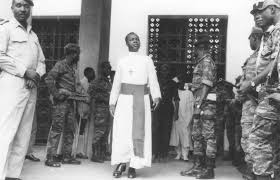
When Bishop Ndongmo returned to Cameroon from his Vatican summit, the regime offered no mercy; he was immediately arrested on August 27, 1970, for alleged complicity in a rebellion plot.
On the morning of August 29, 1970, the prominent newspaper The Cameroon Times ran a bold lead story that shook the Anglophone and Francophone intelligentsia. The front-page headline screamed:
"Bishop Ndongmo arrested for alleged subversion."
Crucially, within the body of the article, the journalists reported that Ernest Ouandié had voluntarily "given in" to government forces.
The Ahidjo administration was furious.
The political leadership required a narrative of absolute military dominance, and the phrase "given in" implied that the state security apparatus had been unable to hunt Ouandié down through its own strength, thereby making the government look weak.
In a swift display of authoritarian media suppression, the reporter, editor, and publisher of The Cameroon Times were rounded up, arrested, and dragged before a military tribunal on charges of disseminating false information.
The court ruled that the reporting tended to "undermine and ridicule the authority of the state." The truth was an inconvenient political liability; the state insisted he was captured by force, not that he surrendered out of his own free will. For the simple crime of writing the truth, the journalists were sent to prison.
The Trial and the Final Words
The ensuing military tribunal was a political theatrical display. The verdict was predetermined in the presidency, and Ouandié was convicted of treason and sentenced to face a public firing squad.
Ahidjo intended the execution to serve as a public spectacle of terror to completely break the remaining spirit of the UPC nationalist movement.
But on the morning of January 15, 1971, at the public square of Bafoussam, Ouandié denied them their psychological victory.
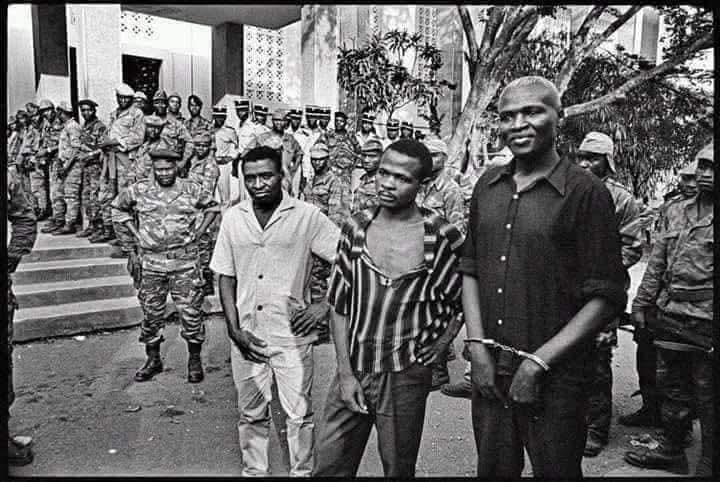
Handcuffed and marched to the stakes alongside his revolutionary brothers, Gabriel Tabeu ("Wambo le Courant") and Raphaël Fotsing, he stood straight and unbroken. When the executioners stepped forward with cloth to blindfold him, he refused it with a calm serenity that stunned the forced assembly of market women and school children.
Facing the firing squad commanded by a French military officer, he bellowed his final testament:
"Long live Cameroon, history will judge! Tell my wife and my children that I did not betray."
He did not beg for his life, nor did he ask the state for mercy. He wanted only one message to pierce through the state's propaganda machinery: that he had remained unbent, unbought, and absolutely faithful to the cause of Cameroon's sovereignty to his last breath.
The French officer gave the command, and a volley of rifle fire cut the three nationalists down. Stepping forward over the fallen bodies, the French commanding officer drew his sidearm and personally delivered the definitive coup de grâce to Ouandié's head.
The Concrete Grave and the Plastic Band
Hoping to erase their memory from the physical earth, the Ahidjo government refused to release the remains of Ouandié, Tabeu, and Fotsing to their families.
Under heavy military guard, the three bodies were taken to a secluded, unmarked trench within the Bafoussam-Plateau Cemetery.
The bodies were thrown in, and the military poured a thick layer of industrial concrete over the communal grave to prevent it from ever being found or transformed into a shrine of martyrdom by the population.
For twenty years, the families were left in agonizing silence, denied even the dignity of knowing where their bones lay.
Decades later, during the democratic openings of the 1990s, human rights investigators and surviving comrades finally obtained permission to breach the concrete barrier and exhume the trench.
Deep beneath the shattered concrete, they discovered three skeletons, seemingly indistinguishable after years of decay.
But as the forensic team carefully cleared the earth from the bones, they discovered a stunning detail. Tied tightly around the radius and ulna of one skeleton's wrist was a small, preserved piece of plastic — a crude band tied by an anonymous hand.
It was not military or government issue. It was a final, perilous act of silent resistance executed at the edge of the pit. Someone — perhaps a sympathetic gendarme, a grave digger, or a hidden comrade — had secretly marked the body of Ernest Ouandié before the concrete was poured.
That simple plastic band allowed his family and the nation to definitively identify his remains. Even in the deepest darkness of the police state, someone had refused to let the commander be forgotten.
The Rehabilitation: National Hero
For twenty years following the execution, uttering the name of Ernest Ouandié in public was a crime against state security. He was systematically demonized in state textbooks as an outlaw, a terrorist, and an enemy of peace.
But history possesses a patient way of correcting the lies of dictators.
On December 16, 1991, following an immense wave of popular pro-democracy protests that shook the successor regime of Paul Biya, the Cameroonian Parliament passed an extraordinary legislative act. The state officially rehabilitated his memory and proclaimed Ernest Ouandié a National Hero of Cameroon.
The rebel they had tried to execute, bury in concrete, and erase from time was formally written into the eternal ledger of the fatherland. The traitor was revealed as the patriot.
"A belated recognition, insufficient for many, but which confirms what history never ceased to whisper: he did not betray."
The Final Days
Life Journey
But What If
What if the catechist had kept silent? What if Ouandié had never been captured?
If he had died of old age in the forest, the UPC would have retained a symbolic leader in the field. A flicker of hope. The knowledge that the resistance was still alive.
What if the government had shown mercy?
A public execution was a choice, not a necessity. Ahidjo could have sentenced Ouandié to life in prison. He could have used him as a bargaining chip.
Instead, he chose spectacle. He wanted Ouandié's death to be a warning.
But spectacles work both ways. Ouandié's execution became a rallying cry for a new generation.
What if Ouandié had fled into exile? He could have lived in Europe or Africa, writing memoirs, waiting for history to turn. He chose to stay. He chose to fight. He chose to die with his comrades.
Three Intriguing Questions
Published April 23, 2026 — 55 years after the execution