By 1884, the Douala people of the Cameroons coast were already accustomed to Europeans. German trading firms — Woermann, Jantzen & Thormälen — had operated in Douala for years. The British were also present, but less aggressively.
The Douala kings, King Ndumbe Lobe Bell and King Akwa, had a problem: they needed protection from rival German merchants who were becoming aggressive. They also wanted to preserve their trading monopoly.
Because they preferred the English, they wrote to the British and London reluctanly instructed Consul Edward Hyde Hewett to secure the Cameroons coast. He left London. He arrived in Lagos. And there he stayed — for days. And this was a well known reason.
The British were reluctant to take the Cameroons because They had the Gold Coast, Lagos, and the Oil Rivers Protectorate (later Southern Nigeria). Adding the Cameroons would have been logical, but London hesitated.
The Germans profited from the British delay and moved fast to secure thier interests.
What Happened on July 11, 1884 (The Preliminary Treaty)
On the evening of July 11, 1884, Consul Gustav Nachtigal — a German government official — negotiated a treaty with King Bell and King Akwa.
The Douala kings presented a list of 11 conditions. They wanted to preserve their middleman trading monopoly. Nachtigal accepted their conditions to get them to the table.
What this treaty promised:
- The Douala kings would accept German "protection"
- Their commercial monopoly would be protected
- German traders would not compete unfairly with Douala merchants
Who negotiated this treaty?
- Gustav Nachtigal (German government)
- King Bell
- King Akwa
This was a government-to-king agreement. It looked fair. The kings believed they had secured their trading rights.
The kings went to sleep on July 11 thinking they had made a good deal.
What Happened on July 12, 1884 (The Final Treaty)
The next morning, something changed.
Nachtigal stepped back. He did not sign the final version. Instead, the treaty was presented again — but this time signed by German businessmen, not the German government.
This was a strategic move by Otto von Bismarck, the German Chancellor. By keeping the "Protectorate" as a private commercial venture initially, the German government could stay at "arm's length" and avoid immediate diplomatic friction with Britain.
Who signed this treaty?
- Ed. Schmidt (representing Woermann firm)
- Joh. Voss (representing Jantzen & Thormälen)
- Ed. Woermann (witness)
- O. Busch (witness)
- King Bell
- King Akwa
- 22 other Douala signatories
Notably missing: Gustav Nachtigal. His name is not on the final document. Bismarck deliberately kept the German government at arm's length.
What changed in this version?
The clause protecting the Douala commercial monopoly was quietly removed. The final document was a stripped-down version that favored German commercial expansion.
In plain English:
- On July 11, the kings were promised protection and their trading rights would be safe.
- On July 12, they signed a document that gave Germany protection but said nothing about their trading rights.
- Whether through mistranslation, confusion, or pressure, they signed away more than they intended.
The Text They Signed
The final treaty said:
"We give this day our rights of sovereignty, the Legislation and Management of this Country entirely up to Eduard Schmidt acting for the firm C. Woermann, and Mr Johannes Voss acting for Mssrs Jantzen and Thormälen, both in Hamburg."
In plain English: The kings gave away the right to rule themselves to two businessmen. They could no longer make their own laws or control their own territory.
But the treaty also included this clause:
"Land cultivated by us now, and the places the towns are built on, shall be the property of the present owners and their successors."
In plain English: Your farms and villages stay yours. Your children will inherit them.
This clause was the only protection the kings kept.
The Event Horizon: July 14, 1884
Two days after the treaty was signed, on July 14, 1884, Dr. Max Buchner officially hoisted the German flag over the Cameroons coast.
This was the moment the timeline split.
Before the flag went up: The treaty was just a piece of paper. There was still room for negotiation, for delay, for the British to intervene.
After the flag went up: Germany had made its claim visible. To challenge it now would mean war with a European power. Britain would not risk that.
The flag is the "Event Horizon." After that moment, the Douala kings could not go back.
One King Refused to Sign
Prince Lock Priso of Hickorytown (Bonabéri) refused to put his mark on the treaty. He recognized the trap.
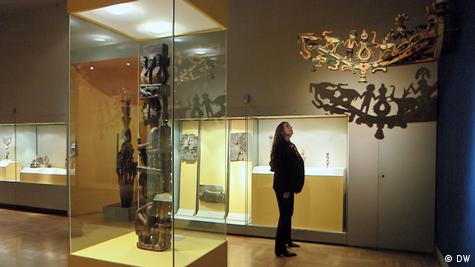
From December 10 to 22, 1884, he led an open war against the Germans. They crushed his resistance. They seized his royal emblem, the Tangué (the ornate prow of a royal racing canoe), as war booty.
Today, the Tangué remains in the Museum of Ethnology in Munich. The struggle for its restitution continues. His descendants still seek its return.
But What If
What if the kings had waited one more week?
If King Bell and King Akwa had delayed signing, or if Hewett had sailed faster, the treaty would have been with Britain instead of Germany. The German flag would never have been raised.
No German Kamerun. The German colonial period (1884-1916) would not have occurred. The brutal suppression of resistance, the plantation economy, the forced labor — none of it would have happened on Cameroonian soil.
No partition after WWI. After Germany lost the war, its colonies were seized. France took four-fifths. Britain took one-fifth. The modern Anglophone-Francophone divide was born from that split. If Britain had already controlled the entire territory from 1884, there would have been no partition. No division. No split.
A single British colony. Cameroon would have developed under British common law, English education, and parliamentary traditions from the beginning. It might have been governed as an extension of the Oil Rivers Protectorate (later Southern Nigeria). Independence would likely have come in the early 1960s, alongside Nigeria, Ghana, and Kenya.
No expropriation of the Joss Plateau. No forged letters. No hanging of Rudolf Douala Manga Bell. The Tangué might still be with Lock Priso's descendants.
Seven days. A faster ship. A more urgent consul. Any of these could have rerouted the entire history of the Cameroons.
The counterfactual is not that British colonialism would have been kind. It is that the specific wounds of German rule — the expropriation, the hanging of King Bell's son, the seizure of Lock Priso's Tangué — would not have occurred. And the partition that divided Cameroon into two halves, French and British, would never have been necessary.
The Promise Broken (1910-1914)
For thirty years, the land clause held. The Douala kept their farms and villages.
Then, in June 1910, the German colonial administration issued a decree expropriating the lands of Joss, Bonapriso, Akwa, and Deido.
They planned to create a "Free Zone" — a one-kilometer buffer separating Europeans from Africans. The people of Douala were to be "relocated" to new sites ironically named Neu Bell, Neu Akwa, and Neu Deido.
King Rudolf Douala Manga Bell, son of King Bell, led the resistance. He took the fight to Berlin, petitioning the Reichstag to honor the 1884 treaty's land clause. His legal petitions were actually gaining traction in Berlin. The Germans needed a way to silence him.
The colonial government responded with a lie. They forged a letter showing Rudolf plotting with the British — an act of treason in the eyes of the Reich.
On August 8, 1914 — just days after the outbreak of the First World War (Germany declared war on Russia on August 1, and on France and Britain on August 3-4) — Rudolf Douala Manga Bell and his secretary Adolf Ngosso Din were hanged in Douala.
The paper promise meant nothing.
Three Intriguing Questions
1. The Week That Changed Everything
Seven days separated Cameroon from becoming a British colony. If Consul Hewett had arrived on July 11 instead of July 19, would Cameroonian schoolchildren today be learning British history instead of French? Would Douala's markets speak English or Pidgin as their lingua franca?
2. Two Treaties, One Deception
On July 11, the kings were promised protection for their trade. On July 12, that clause was gone. Did they notice? Did anyone explain the difference? Or was the treaty presented in a language they could not fully read? We may never know — the original English version of the treaty has mysteriously disappeared. Only the German translation remains.
3. The Land That Was Promised
Article 3 promised that land would stay in Douala hands. In 1914, the family of King Bell was expelled and executed. The descendants of Prince Lock Priso still seek the return of his Tangué from a museum in Munich. If a colonial power violates its own treaty, what recourse do the signatories have — then or now?
Published April 20, 2026 — 136 years the Douala kings lost thier sovereignty