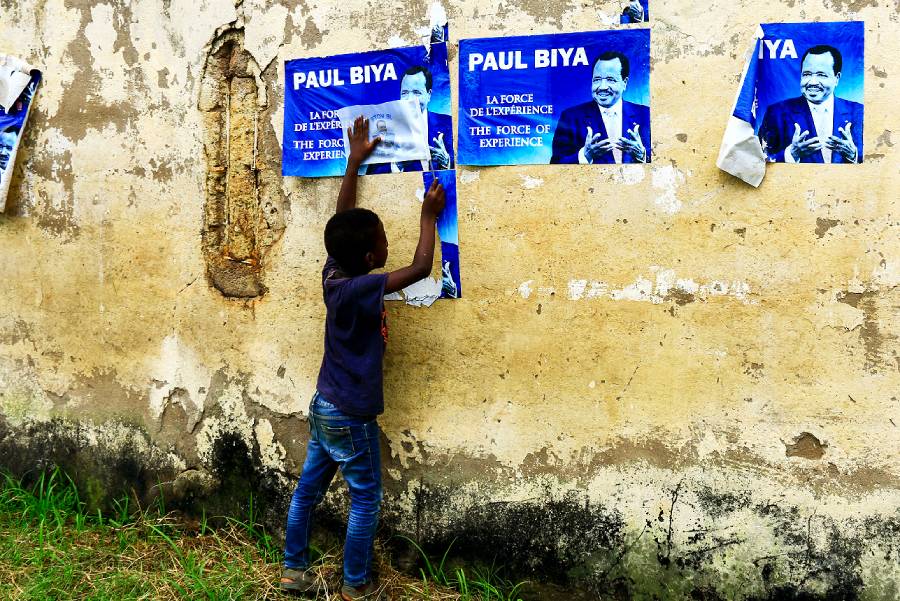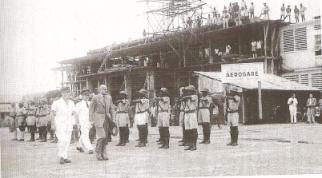
For decades, Cameroon’s unique identity was defined by a rare historical experiment: Francophones and Anglophones living, working, and creating a nation together.
Neighbors shared bowls of eru and achu alongside plates of ndolé. Intermarriages bridged regional divides, and the streets echoed with a fluid, electric mix of French, English, Pidgin English, "Mboko," and the modern "Fran-Anglais" (Camfranglais) spoken by the new generation.
This unique linguistic melting pot became a cultural bridge. It is what allows Anglophone and Francophone artists to seamlessly collaborate on massive Afrobeats, Afropop, and urban rap tracks, fusing their voices to create a cultural force that resonates across the globe.
This cultural synergy translated into legendary national achievements. On the football pitch, the Indomitable Lions united the country like nothing else, capturing five Africa Cup of Nations (AFCON) titles and transfixing the world during their historic run to the World Cup quarterfinals in 1990.
In a volatile Central African region plagued by civil wars, coups, and instability, Cameroon stood as an island of peace, predictability, and economic promise.
But in late 2016, that legendary stability fractured.
What began as peaceful, corporate strikes by Anglophone lawyers and teachers protesting the systemic over-centralization of French-trained judges and educators in their schools and courts rapidly transformed into a full-blown national crisis.
The Anglophone population felt their distinct common-law judicial system and Anglo-Saxon educational heritage — the very pillars of their cultural identity — were being systematically eroded by the centralized state in Yaoundé.
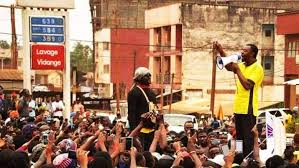
As peaceful protests escalated, a rigid government stance, coupled with heavy-handed crackdowns and internet shutdowns, closed the door on early dialogue. Radicalized by the state's response, fringe nationalist groups picked up arms, declaring the symbolic independence of a breakaway state called "Ambazonia".
By 2020, the crisis degenerated into a brutal, protracted armed conflict in the Northwest and Southwest regions. Separatist militias and state security forces clashed, displacing over 500,000 civilians, keeping hundreds of thousands of children out of classrooms for years, and shattering the long-held myth of absolute Cameroonian peace.
How did one of Africa’s most stable nations find itself in this tragic impasse?
To understand the gunshots of today, we have to look past the immediate politics and trace the structural fault lines back to where the blueprint of the nation was first drawn: the historic July 1961 Foumban Conference.
"The 2016 crisis didn’t come out of nowhere. It was the eruption of a volcanic structural fault line left unaddressed since 1961." — 237 Rewind Analytical Insight
The Long Road to Foumban (1914–1961)
To truly understand why the two Cameroons sat across from each other in July 1961, we have to rewind the tape to the brutal, transimperial battlegrounds of World War I.
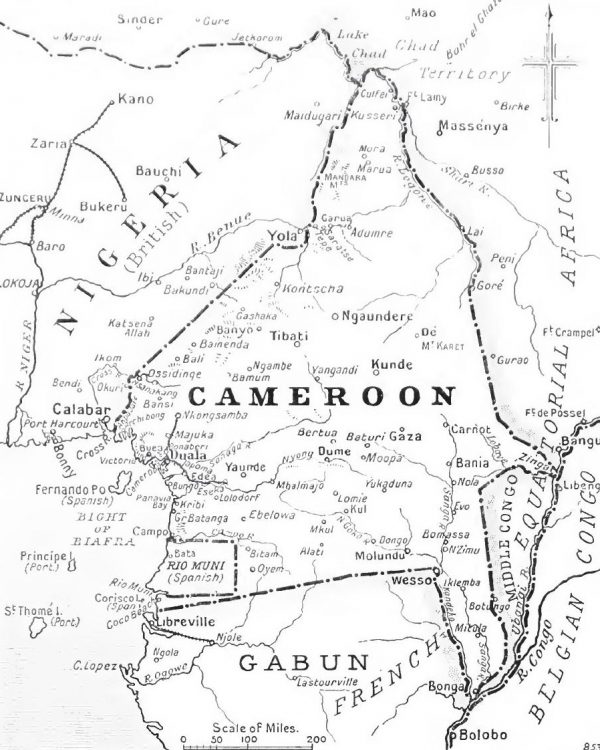
In August 1914, German Kamerun became an immediate target for the Allied powers. A combined force of British, French, and Belgian troops invaded the protectorate from all sides, seeking to oust the German administration.
The Escape of Ebermaier and the Last Stand at Mora
By early 1916, the German defensive lines were utterly fractured. Allied forces were tightening a noose around the temporary capital of Jaunde (Yaoundé).
Recognizing that military defeat was inevitable, the German Imperial Governor, Karl Ebermaier, and his military commander, Colonel Carl Zimmermann, executed a stunning tactical maneuver to avoid a humiliating unconditional surrender on Cameroonian soil.
Instead of laying down their arms to the British and French, Zimmermann ordered a massive, coordinated retreat southward.
On February 4, 1916, Governor Ebermaier, Colonel Zimmermann, 1,000 German nationals, and a staggering vanguard of 40,000 loyal Cameroonian Schutztruppe soldiers, carriers, and local chiefs crossed the Campo River into the neutral territory of Spanish Guinea (Río Muni, modern-day Equatorial Guinea).
By crossing into neutral territory, the core German administration successfully evaded capture, finding safe asylum under the Spanish flag on the island of Fernando Po until the end of the war.
Meanwhile, in the mountainous Far North, a single isolated contingent refused to abandon the fight.
Huddled on the rocky peaks of the Mandara Mountains, Captain Ernst von Raben commanded the fortified outpost of Mora. Under relentless attack since August 1914, Raben survived the Siege of Mora — the second-longest siege of the entire global war.
It was not until February 15, 1916, that Allied forces managed to get a message through to Raben, informing him that Governor Ebermaier had escaped and the rest of the country had fallen. Realizing he was the absolute last German standing in Africa, Raben agreed to negotiate terms.
Displaying remarkable leverage for a defeated commander, he refused to surrender until the British Brigadier, Frederick Hugh Cunliffe, agreed to pay £2,000 in cash to cover the back-wages of Raben’s indigenous African soldiers (Askaris) and allowed them to return to their villages unmolested.
On February 18, 1916, Raben marched down the mountain, officially ending the Great War in Cameroon.
The Treaty of Versailles and the Imperial Scar
The departure of the Germans left a massive imperial vacuum that changed the geometry of the territory forever.
On March 4, 1916, British and French officials drew a hasty, provisional administrative border known as the Picot Line, ripping the old German Kamerun into two uneven pieces.
This wartime colonial land-grab was formally legalized on the global stage on June 28, 1919, under Article 119 of the Treaty of Versailles. Germany was forced to formally renounce all sovereign rights over its colonies.
The League of Nations subsequently turned the territory into Class B Mandates in 1922 (later upgraded to United Nations Trusteeships in 1946):
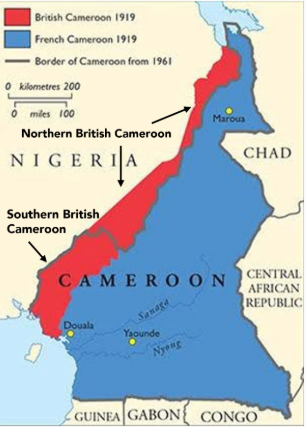
French Cameroun: France assumed control over four-fifths of the territory, tying its administrative, monetary, and legal structures directly to Paris.
British Cameroons: Great Britain claimed the remaining one-fifth along the Nigerian border, dividing it into Northern and Southern Cameroons and ruling it cheaply as a minor appendage from Enugu, Nigeria.
For nearly forty years, these two separate blocks developed completely different institutional DNA. They absorbed opposite legal traditions (French Civil Law vs. British Common Law), separate currencies, divergent educational models, and completely clashing political cultures.
The United Nations Deadlock and the 1961 Plebiscite
The modern crisis was officially triggered when French Cameroun achieved its complete independence on January 1, 1960, becoming the Republic of Cameroon (République du Cameroun). Suddenly, the UN and the British administration had to resolve the legal status of the remaining British trusteeship.
The Anglophone political leadership pushed hard for a "Third Option" — total independence as a separate, standalone sovereign nation.
However, major global powers within the United Nations, alongside Great Britain, flatly rejected this request. They argued that the small territory was economically unviable on its own.
Instead, the UN General Assembly passed Resolution 1352 (XIV), forcing a strict binary choice onto the population through a public vote. The historic UN Plebiscite took place on February 11, 1961.
The ballot presented two definitive questions:
- Do you wish to achieve independence by joining the independent Federation of Nigeria?
- Do you wish to achieve independence by joining the independent Republic of Cameroon?
The results split the British territory permanently. The Northern Cameroons voted decisively to merge with Nigeria. In the Southern Cameroons, driven by a deep fear of political domination by Nigerian ethnic majorities, the population voted overwhelmingly (233,571 votes to 97,741) to achieve independence by joining Ahmadou Ahidjo’s Republic of Cameroon.
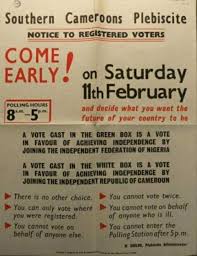
The UN formalized this vote through Resolution 1608 (XV) on April 21, 1961, establishing that the trusteeship would officially terminate on October 1, 1961.
The resolution explicitly mandated that the governments of the Republic of Cameroon and the Southern Cameroons must immediately hold high-level constitutional talks to finalize the terms of their new union before the October deadline.
That urgent international directive is what led directly to Foumban.
The Foumban Conference: Logistics, Delegates, and Treaties
The historic Foumban Constitutional Conference took place from July 17 to July 21, 1961.
The cross-river meeting was deliberately hosted in the ancient capital of the Bamoun Kingdom to provide a culturally symbolic African backdrop far away from the colonial architecture of Yaoundé or Buea.
The Delegations: Who Was at the Table?
The conference brought together the political elite of both territories.
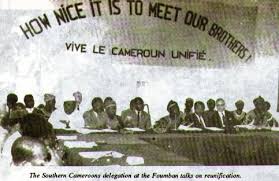
The Republic of Cameroon (Francophone Delegation): Led directly by President Ahmadou Ahidjo, accompanied by Prime Minister Charles Assalé, and a sophisticated team of French legal advisors and constitutional technicians.
The Southern Cameroons (Anglophone Delegation): Spearheaded by Premier John Ngu Foncha (leader of the KNDP). To present a facade of regional unity, Foncha brought a multi-party coalition that included his fierce political rival Emmanuel Endeley (leader of the CPNC), alongside key regional figures like Solomon Tandeng Muna, Augustine Ngom Jua, and P.M. Kemcha.
The Conference Logistics and the Treaty Mechanism
The conference was characterized by a sharp imbalance in working styles. Ahidjo’s team arrived with a fully drafted, legally binding constitutional text.
Foncha’s delegation, having spent the previous weeks in informal, loose discussions at the All-Party Constitutional Conference in Bamenda(June 26 to June 28, 1961. ), expected to engage in an open, paragraph-by-paragraph debate to write an entirely new document from scratch.
July 17, 1961 (Opening Day): President Ahidjo opens the summit with a calculated speech welcoming his "returning brothers," but immediately lays down the baseline: he presents a pre-drafted text that is simply an amendment to the existing 1960 Francophone constitution.
July 18–20, 1961 (The Separation): Instead of joint interactive debates, the two delegations are separated into different working rooms. The Anglophone delegates are left to review Ahidjo’s French text, frantically translating it and writing a list of proposed amendments to protect their regional autonomy, such as a loose federation with a dual-chamber parliament.
July 21, 1961 (The Closing): Ahidjo meets with the Anglophone delegation, accepts a few minor symbolic adjustments (such as adding a second star to the national flag to represent the two states), but firmly rejects all proposals that threaten central presidential authority.
The Result: A Constitutional Sandcastle
No formal international treaties, bilateral accords, or even joint declarations were signed on the final day of Foumban.
Instead, the conference concluded merely with an informal verbal agreement on a revised draft text.
Ahidjo’s delegation rushed this text back to the Francophone National Assembly in Yaoundé, which formally ratified it on August 1, 1961, as the Federal Constitution of the Republic of Cameroon.
This mechanism contained a fatal, asymmetrical legal flaw: the supreme law governing both Anglophones and Francophones was passed by a parliament where Anglophones had absolutely zero seats, zero votes, and zero representation.
The Southern Cameroons House of Assembly in Buea never voted on or ratified this federal document. The union was legally established on October 1, 1961, not by a joint treaty, but by a domestic law passed within a single state's legislature.
The Asymmetrical Trap
With the historical facts fully laid bare, the raw structural mechanics of the "Asymmetrical Trap" become clear.
John Ngu Foncha and his team believed they were participating in an equal partnership between two sovereign entities. In reality, they stepped into a highly coordinated constitutional net.
The Sovereign Disparity: Ahidjo was the recognized head of a country that already possessed a central government, a functioning military, seats at the UN, and direct international backing. Foncha was merely the administrator of a transitioning UN trust territory with zero external sovereign power.
The Constitutional Capture: Instead of co-creating a brand-new federal framework, the Anglophone delegation allowed the existing 1960 Francophone state structure to simply expand and swallow their territory.
The resulting Federal Constitution concentrated supreme executive power in the office of the President (Ahidjo), giving him the unilateral authority to appoint federal inspectors to oversee the regional states and command all national security forces.
By accepting a constitution where the central executive held all the structural keys, the Anglophone leadership unwittingly signed a contract that left the survival of their regional autonomy entirely dependent on the good faith of an autocrat.
Eleven years later, in May 1972, Ahidjo would use that exact same concentrated structural power to dissolve the federation entirely.
The Global Blueprint: How Unions Are Supposed to Happen
To understand just how precarious this arrangement was, one only needs to look at how similar international unions were executed elsewhere during the same era:
The United Republic of Tanzania (1964): When Julius Nyerere’s Tanganyika and Abeid Karume’s Zanzibar decided to merge, they did not rely on verbal agreements. They drafted the Articles of Union, a formal, binding international treaty between two distinct legal entities.
Crucially, this treaty had to be explicitly and separately ratified by both the National Assembly of Tanganyika and the Revolutionary Council of Zanzibar to become legally active. Zanzibar retained its own distinct president, parliament, and local laws, protected by a treaty that neither side could unilaterally rewrite without breaking international law.
The United Kingdom (1707): Centuries earlier, when England and Scotland united, they executed the Acts of Union. This required identical, separate pieces of legislation to be thoroughly debated, voted upon, and passed by both the independent Parliament of England and the Parliament of Scotland.
At Foumban, this standard was entirely bypassed. By allowing a verbal agreement to be translated into a domestic law passed solely in Yaoundé, the Anglophone leadership inadvertently set a dangerous precedent.
They treated a historic, international union of two distinct peoples as if it were a simple administrative merger, leaving the door wide open for Ahidjo to alter the terms of the contract whenever it suited him.
The True Collapse — The Dissolution of the States (1961–1972)
Because the 1961 union was built on a domestic law passed solely in Yaoundé rather than a binding bilateral international treaty, the federal presidency faced no international legal barriers when it began to systematically dismantle the autonomy of West Cameroon.
Legally, the country was a two-state federation: East Cameroon (Francophone) and West Cameroon (Anglophone), each with its own regional prime minister, local parliament, and distinct cultural institutions.
However, over the course of eleven years, Ahmadou Ahidjo used his concentrated federal executive authority to structurally strangle the Anglophone state.
1. Fiscal and Economic Suffocation
The federal government quickly moved to centralize all major revenue collection. Customs duties from the bustling ports of Victoria (now Limbe) and Tiko, which had previously funded the Southern Cameroons treasury, were diverted entirely to the federal capital.
Furthermore, through Ordinance No. 62/OF/24 of February 7, 1962, the British West African Pound was abolished, forcing West Cameroon to adopt the CFA Franc. This transition disrupted local trade networks with neighboring Nigeria and left the Buea-based Anglophone regional administration starved of independent fiscal resources.
The West Cameroon government was reduced to an administrative shell, entirely dependent on federal subventions from Yaoundé just to pay its civil servants.
2. Elite Collaboration and the 1966 Single-Party Fusion
This aggressive centralization was not executed by Ahidjo alone; it relied heavily on the active cooperation of Anglophone political elites. Competing fiercely with each other for personal political favor, access to lucrative federal ministries, and elite status in Yaoundé, Anglophone politicians engaged in deep factionalism.
When Ahidjo proposed merging all political entities, prominent Anglophone leaders willingly dissolved their own regional parties — including John Ngu Foncha's ruling Kamerun National Democratic Party (KNDP) and Emmanuel Endeley's opposition Kamerun People’s National Convention (CPNC) — on September 1, 1966.
They dissolved these independent bodies to merge into Ahidjo's single-party machine, the Cameroon National Union (CNU/UNC). By voluntarily liquidating their own political parties, the Anglophone elite destroyed the only independent legislative mechanisms they had to protect their regional sovereignty.
3. The Constitutional Breach of May 1972
By May 1972, Ahidjo decided to finalize this centralization by abolishing the two-state federal framework entirely. On May 4, 1972, he stood before the Federal Assembly and announced a national referendum to establish a unitary state under a new constitution.
This move contained a profound, undeniable constitutional breach. Article 47 of the 1961 Federal Constitution explicitly stated:
"No electoral procedure or constitutional modification can be accepted if it compromises the unity and the federal structure of the Republic."
Furthermore, any valid constitutional amendment required separate, specific approvals from the regional legislative assemblies.
Instead of seeking this required parliamentary approval within the West Cameroon House of Assembly, Ahidjo bypassed the clause entirely. He subjected the structural existence of the minority Anglophone state to a sweeping national popular vote.
Because the Francophone population was overwhelmingly larger, the minority Anglophone vote was structurally drowned out. The referendum on May 20, 1972, returned an official, Soviet-style 99.9% victory for centralization. With the stroke of a pen, the Federal Republic was dissolved, replaced by the "United Republic of Cameroon," and the institutional autonomy of West Cameroon was officially erased.
The Legal Backlash — Fon Gorji-Dinka and The New Social Order (1985)
The structural contradictions of the 1972 centralization lay dormant for over a decade, functioning as a silent undercurrent until a major legislative shift under Cameroon's second president triggered a profound legal backlash.
Following the unexpected resignation of Ahmadou Ahidjo, his handpicked successor, President Paul Biya, signed Law No. 84/01 on February 4, 1984.
This law officially amended the constitution, changing the country’s official name from the "United Republic of Cameroon" back to simply the "Republic of Cameroon" (République du Cameroun).
While the state media presented this change as a simple, modern administrative streamlining to project a singular national identity, the decree created a severe, unprecedented legal vulnerability:
The Reversion Trap: "Republic of Cameroon" was not a neutral title. It was the exact, distinct name that the Francophone state had used before the 1961 Foumban unification took place.
The Secession Rationale: By reverting strictly to the pre-union name of the Francophone republic while continuing to administer the geographic territory of the former British Southern Cameroons, the central government in Yaoundé had committed a major geopolitical error.
Recognizing this critical constitutional opening, a prominent Anglophone jurist, activist, and traditional ruler — Fon Fongum Gorji-Dinka (the first president of the Cameroon Bar Association) — published an explosive, historic legal brief on March 20, 1985, titled The New Social Order.
Dinka’s thesis cut through the state's narrative with sharp, analytical precision. He argued that by unilaterally changing the national name back to the pre-union title of the Francophone state, the Yaoundé regime had legally and technically seceded from the 1961 union.
Consequently, by erasing the "United" framework while continuing to station its military forces, administrators, and courts in the Anglophone sector, the central government had technically transformed its presence from a constitutional partnership into an illegal colonial annexation.
It was within this specific 1985 legal manifesto that Fon Gorji-Dinka formally coined the name "Ambazonia" — derived geographically from Ambas Bay, the coastal waters of the Atlantic Ocean in the Southwest Region — to define the separate, distinct international legal identity of the Anglophone territory.
Dinka's document was not a simple emotional grievance; it provided the precise constitutional, legal framework that would animate the modern Ambazonian self-determination and secessionist movements decades later.
"By changing the name back to République du Cameroun, the state technically dissolved the legal framework of the 1961 union."
— Fon Fongum Gorji-Dinka, The New Social Order (1985)
The "What If" Matrix — Exploring the Three Alternate Realities
Every historic crossroads contains multiple unmapped realities.
When the Anglophone leadership navigated the structural traps of the 1960s and 1970s, their choices were shaped by real, overlapping geopolitical risks.
For an objective history blog like 237 Rewind, we must test the alternate dominoes of the three distinct paths available to the Southern Cameroons leadership.
What if they had taken a different turn? Let’s unmake the timeline.
Branch A: The Refusal of May 1972 (The Contested Federation)
The Counterfactual Break:
On May 4, 1972, when President Ahmadou Ahidjo stands before the Federal Assembly to announce the referendum to abolish the states, the atmosphere shifts. Instead of sitting in compliant silence, Vice-President John Ngu Foncha, S.T. Muna, and the entire West Cameroonian legislative delegation stand up and walk out of the parliament in a unified, coordinated protest.
They invoke Article 47 of the 1961 Constitution, declaring that the federal structure cannot be subjected to a national referendum without the explicit prior consent of the West Cameroon House of Assembly in Buea.
The Consequence:
Ahidjo faces a severe domestic and international constitutional blockade. Bypassing a unified Anglophone legislative walkout would ruin his image as a democratic unifier on the global stage. The national referendum is suspended.
The Federal Republic survives on paper, preserving the distinct Anglo-Saxon educational framework and the independent Common Law judiciary of West Cameroon. However, this alternate timeline is far from a peaceful utopia.
In retaliation for the walkout, the centralized presidency in Yaoundé uses its control over national revenue to completely starve the West Cameroon regional state of financial subventions. Buea is plunged into an acute economic depression, unable to pay its civil servants, teachers, or police.
The region becomes a highly contested, economically isolated, and militarized enclave within an incredibly tense, deadlocked union.
Branch B: Voting to Join Nigeria in 1961 (The Biafra Trap)
The Counterfactual Break:
Let’s push the tape back an entire decade to the February 11, 1961 UN Plebiscite. In this alternate timeline, John Ngu Foncha’s pro-unification campaign fails to convince the masses.
Emmanuel Endeley’s pro-Nigeria platform wins the day. The population of Southern Cameroons votes decisively to achieve independence by permanently integrating into the Federation of Nigeria.
The Consequence:
Southern Cameroons completely avoids the aggressive centralization of Ahmadou Ahidjo and the French state apparatus.
The territory is integrated into Nigeria as a distinct, self-governing regional province, preserving its British administrative style.But this path leads directly into a massive geopolitical trap.
Six years later, in May 1967, the Eastern Region of Nigeria secedes, declaring the independent Republic of Biafra and sparking the devastating Nigerian Civil War (1967–1970). Because Southern Cameroons shares a direct geographic border with the Biafran heartland and contains minority populations deeply tied to Eastern Nigerian trade networks, the territory is instantly pulled into the conflict.
Southern Cameroons becomes a brutal, frontline theater of war. Federal Nigerian troops occupy the region to secure its ports and prevent Biafran logistics from utilizing Ambas Bay, while secessionist guerrilla factions clash along the Cameroonian grasslands.
Instead of escaping marginalization, the region faces widespread infrastructural devastation, massive civilian casualties, and a catastrophic internal refugee crisis that permanently scars the generation.
Branch C: The Forbidden Option (The Sovereign Standalone State)
The Counterfactual Break:
In late 1960, the United Nations General Assembly succumbs to intense local lobbying from traditional rulers and minor political factions.
The UN alters Resolution 1352 (XIV) and permits a "Third Option" on the February 1961 ballot: Total independence as a separate, standalone sovereign nation.
The population votes overwhelmingly for this standalone independence, rejecting both Nigeria and French Cameroon. On October 1, 1961, the sovereign state of Southern Cameroons hoists its own distinct flag.
The Consequence:
The new nation completely bypasses the structural traps of both Yaoundé and Abuja. It retains 100% control over its own judicial, educational, and political systems.
However, the harsh economic realities of the 1960s instantly catch up with the young country. Left with a tiny population, zero domestic industrial manufacturing infrastructure, and an economy entirely dependent on raw banana, timber, and rubber plantations managed by the Cameroon Development Corporation (CDC), the standalone nation faces immediate financial vulnerability.
Great Britain refuses to subsidize its budget, and its currency faces severe speculative attacks on the global market.
Starved of capital, the young state is forced to sign deeply asymmetrical economic agreements, turning itself into a heavily dependent neo-colonial protectorate of London just to avoid bankruptcy.
Furthermore, without a strong central military apparatus, internal political fractures rapidly emerge, as rival regional elites clash violently over the territory's limited fiscal resources.
The Three Questions
We have unmapped the choices, the constitutional errors, and the geopolitical risks that built modern Cameroon. Every path from 1961 to 1972 carried a heavy historical cost. Drop your theories in the letter's section below and let's debate these three objective questions:
1. The Foumban Responsibility: Who Owns the Asymmetrical Trap?
When we evaluate the structural deficit of the 1961 union, history often focuses solely on Ahidjo’s calculated centralization.
But how much blame lies with the Anglophone political leadership? Did Foncha and his team fail their people by arriving at Foumban under-prepared, without legal experts, and fractured by local partisan rivalries, or were they simply outmatched by a sovereign state backed by the global machinery of the French empire?
2. The Unveiled Alternatives: Which Risk Was Worth Taking?
Let's look at the alternate paths in our matrix. Joining Nigeria meant running straight into the devastating frontline horrors of the Biafran War (1967–1970).
Seeking standalone independence meant risking immediate economic collapse, instability, and total dependency on London. Looking back objectively, did the 1961 generation pick the best available option at the time, or was there a better way out?
3. The 1984 Legal Loophole: Oversight or Annexation?
Paul Biya’s 1984 Law No. 84/01 changed the country's name back to the pre-union title, République du Cameroun.
Was this a simple, thoughtless bureaucratic oversight by Yaoundé technicians, or did it structurally dissolve the legal framework of the 1961 union?
Does Fon Gorji-Dinka’s 1985 pamphlet, The New Social Order, represent an absolute truth of international law, or is it a brilliant, retroactive legal manipulation of a minor administrative name change?
This post was published on May 18, 2026 — approximately 54 Mays after the 1972 May Referendum. If you were standing in the Federal Assembly on May 4, 1972, would you have walked out with Foncha, or would you have voted for the Unitary State?